Mar 25th, 2026
Have you ever wondered why a particular scene in a movie stays with you long after it ends? Sometimes it is not the action or spectacle that captures our attention, but something quieter: a conversation, a subtle gesture, or the way the camera shifts between two characters. In those moments, the scene becomes compelling because we sense that something is changing: control of the conversation, the direction of the moment, or the balance of power.
Power dynamics in cinema are one of the key ways directors reveal who holds authority at any given moment on screen. Through character positioning, movement, tone of voice, and the delivery of dialogue, filmmakers can subtly guide the audience’s understanding of who is in control. Camera framing also plays an important role, shifting attention from one character to another and visually reinforcing these changes in authority.
These techniques often pass unnoticed by general audiences. Yet with closer observation, viewers can begin to recognize how filmmakers construct these moments of shifting control. By paying attention to dialogue, performance, and camera movement, we can better understand what the director and writer are trying to tell.
Curious to explore, I found myself paying closer attention to how these moments unfold on screen. As someone who loves watching movies, I find it fascinating to look beyond the surface and notice how filmmakers construct these subtle shifts of power.
In the following sections, I look at several scenes that, in my view, clearly illustrate power dynamics at work. These examples come from some of my favorite moments in film and television: There Will Be Blood, Avatar: Fire and Ash, and Episode 2 of A Knight of the Seven Kingdoms. Each scene reveals how authority on screen can shift through dialogue, character behaviour, and cinematic framing.
Scene I – There Will Be Blood (dir. Paul Thomas Anderson)
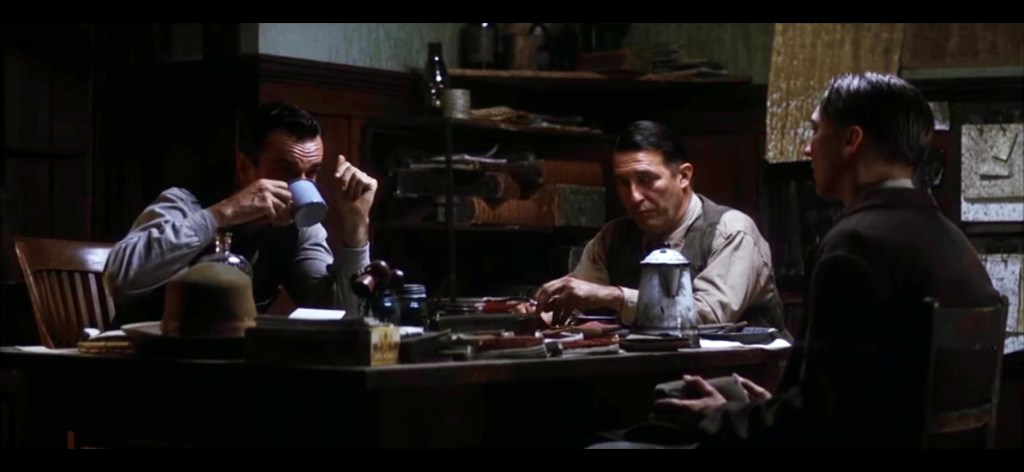
In There Will Be Blood (2007), directed by Paul Thomas Anderson, the early negotiation scene between Daniel Plainview and Paul Sunday offers a compelling example of shifting conversational power constructed through camera movement and framing. At the beginning of the encounter, Paul appears to hold informational power. He initiates the conversation and positions himself as the gatekeeper of valuable knowledge, the location of oil. The camera initially privileges Paul, focusing on him as he asks who Daniel Plainview is. The camera then switches to Daniel as Paul questions him about his intentions. This framing visually reinforces Paul’s temporary authority. Daniel, though economically superior, is momentarily dependent.
As the scene progresses, the camera widens to reveal a third presence in the room, Fletcher Hamilton. The expansion of the frame destabilizes the initial binary dynamic and introduces a more complex negotiation space. The conversation transitions from inquiry to bargaining when Paul asserts, “I’d like it better if you didn’t think I was stupid.” At this moment, the camera again canters Paul as he demands $500 for the information. His insistence visually and verbally asserts agency.
However, Daniel’s power operates differently. While Paul controls information, Daniel controls capital and long-term strategy. The negotiation becomes a contest between informational leverage and economic dominance. When Daniel asks for more details about the land, the camera focuses on him; when Paul responds, the camera returns to Paul, and then shifts briefly to Fletcher when he questions Paul. This shifting focus visually maps the flow of the conversation. When Daniel ultimately agrees to pay $500, the surface reading suggests Paul has won the exchange, as the camera now focusing on him. The score swells as Paul reveals the information, reinforcing the emotional climax of his apparent victory. Yet retrospectively, the power dynamic appears more ambiguous. Daniel acquires access to oil, the true long-term asset, while Paul exits with a finite sum of money. The scene demonstrates how cinema can stage power as fluid rather than fixed. Through shifting camera focus, spatial composition, and musical cues, the film constructs a negotiation in which power oscillates between characters depending on what form of capital, knowledge or wealth is privileged at any given moment.
The scene is beautifully constructed. At the time I first watched it, I didn’t have the term “power shift” in mind. But looking back, I realize this is exactly how a simple negotiation or business conversation becomes captivating on screen. The camera subtly guides us first focusing on who seems to take charge of the conversation, then shifting to who holds the valuable information, and finally to who appears to be winning the game.
As the story unfolds, we begin to understand that Paul truly matters, even though he disappears from the narrative for a long time afterward. This early exchange sets everything in motion. Whether we see Daniel as the winner or Paul as the one who outplayed him depends on how we interpret power, in the moment or in the long run.
Scene II – Avatar: Fire and Ash (dir. James Cameron)

In Avatar: Fire and Ash (2025), directed by James Cameron, the tent scene between Colonel Quaritch and Varang presents a layered example of situational versus strategic power.
Initially, Quaritch appears to control the encounter. He approaches Varang’s territory with tactical precautions, positioning his men outside as protection. This establishes a visual framework of military authority. However, once inside the tent, removed from his soldiers and external surveillance, the power dynamic shifts. Varang controls the physical space. She isolates Quaritch and even administers a substance that forces him into a state of vulnerability.
The camera supports this transition. During Varang’s monologue about Eywa’s abandonment, the lens focuses intensely on her, accompanied by hallucinatory visual effects. Her emotional authority dominates the scene. Quaritch, temporarily stripped of external reinforcements, appears exposed. The shift occurs when Quaritch chooses to tell the truth: that he needs her as much as she needs him. His assertion reframes the negotiation as one between equals rather than conqueror and subordinate. The score falls silent during this moment, heightening the psychological recalibration of power. Varang’s expression changes subtly, a performance detail that signals recognition. When she says, “I see you,” and Quaritch responds, “Damn right you do,” the exchange crystallizes the shift.
This scene shows us that Varang holds situational power within the tent while Quaritch retains strategic power beyond it. By the end of the scene, when he provides her clan with weapons and military equipment, the alliance appears mutually empowering but potentially destabilizing. The film invites the audience to question whether arming the Ash clan strengthens Quaritch’s objective or plants the seeds of future rebellion. Power here is transactional and volatile, not absolute.
Scene III – A Knight of the Seven Kingdoms, Season 1 Episode 2
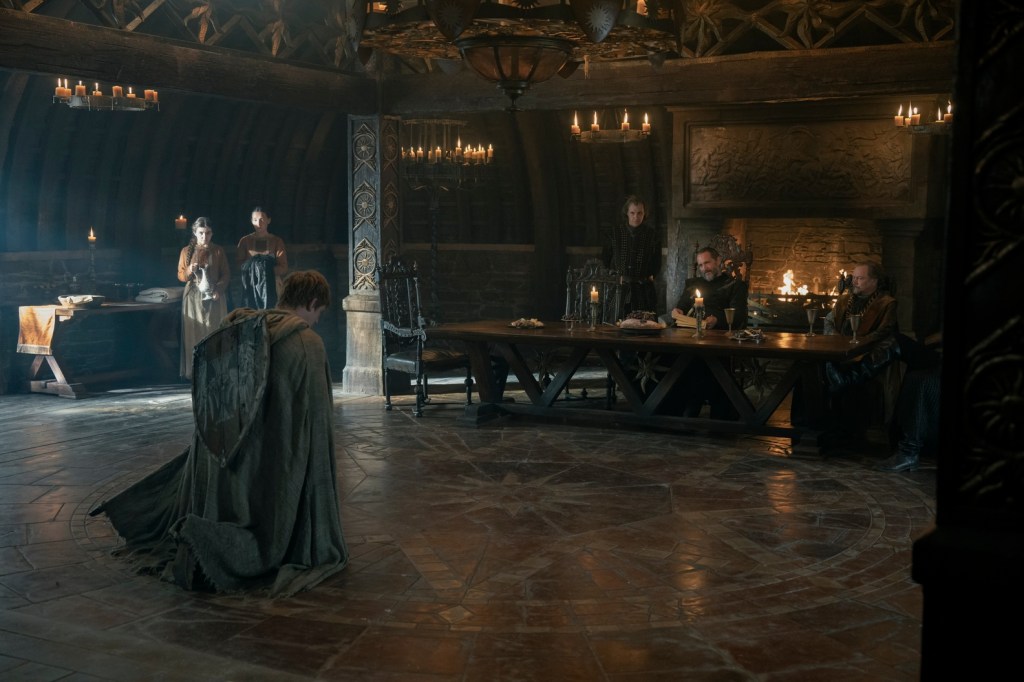
Not so long ago, many of us were captivated by HBO’s A Knight of The Seven Kingdoms. In the series, the encounter between ‘Dunk’ Ser Duncan the Tall and Prince Baelor Targaryen in Lord Ashford’s hall demonstrates how power can manifest through conduct rather than coercion.
When Dunk is accused of intrusion by Prince Maekar Targaryen for eavesdropping, the initial hierarchy is clear: princes outrank hedge knights. Yet Baelor subtly reorients the power dynamic. He reminds his brother that they are guests, not authorities, and addresses Dunk as “Ser,” granting him provisional legitimacy before verifying his claim.
Here, power shifts through rhetorical framing. Baelor exercises authority not by humiliation but by restraint and fairness. He allows the unknown hedge knight to explain himself. When Dunk references his late master, Ser Arlan of Pennytree, hoping the prince might remember him, Baelor tests him with a detail only a true squire would know, a quiet verification, a way to see whether Dunk is truly the man he claims to be.
The exchange about the number of lances broken, four or seven, becomes less about factual accuracy and more about recognition and dignity. Even if Dunk is mistaken, Baelor preserves his honour rather than exposing or embarrassing him in front of the hall.
This interaction constructs Baelor’s authority as ethical rather than positional. Though he is heir to the Iron Throne, his power derives from composure, memory, and equitable treatment of others. When he ultimately signals that Dunk should be allowed to enter the tourney, he demonstrates influence without overt command.
The scene suggests that in Westeros, legitimacy is not only inherited but performed. Power resides in bearing, speech, and moral consistency. Later events in the series reinforce this characterization, but even within this brief exchange, the audience understands Baelor as a leader whose authority stabilizes rather than intimidates.
Power shifting in the cinema reveals itself through subtle a shift in camera focus, the silence or swell of a score, and the way actors carry their characters into life. With all of these, or even one of the these elements, can guide our attention, sometimes quite telling us who gains power in the scene. Well, of course you may disagree with my explanation above, because not everything are entirely true for all audience. What feels like a shift in power to one person might feel entirely different to another. At least, this is how I see it. Anyway, this is just one of my wandering thoughts about scenes that rent-free in my mind, moments that linger not because of something grand but because something beneath the surface quietly changed.
 Wandering Monologues